Blossom Blast Saga
- 4.4
- Rating
- 50.00M
- Installs
- Free
- Price

 Analysis by App-foxy
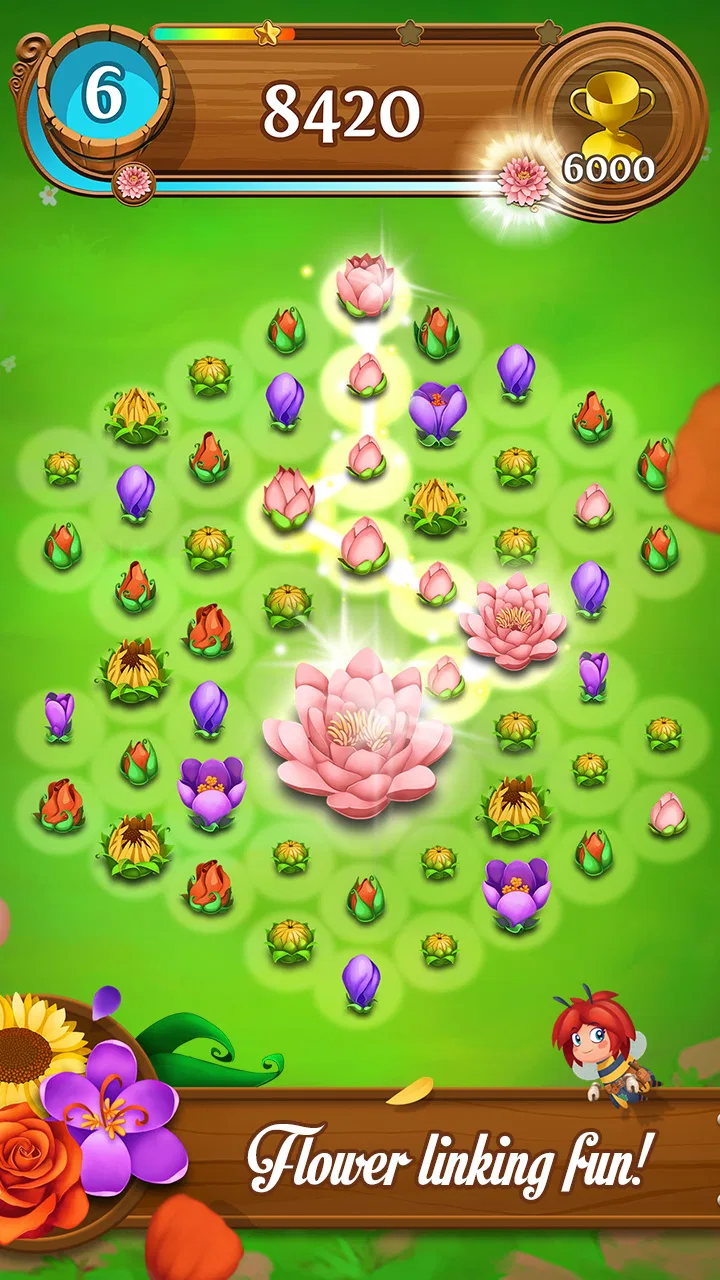
I first understood the appeal of Blossom Blast Saga after a very ordinary move: I linked a few matching flower buds, watched them join, and saw a larger bloom clear part of the board. The action is simple enough to understand immediately, but the result feels more satisfying than a basic tap-to-match game because the flowers grow before they disappear. That small visual change gives each move a clear sense of cause and effect.
King’s casual game is built around growing a colorful garden through match-three-style puzzles. It is free to download, suitable for Everyone, and available on devices running Android 7.0 or later. The game has been around since October 28, 2015, yet its central idea remains easy to pick up: connect buds of the same color, make them bloom, and work toward the objective of the current board.
After spending time with it, I see the game as a good fit for short, low-pressure bursts rather than long, demanding play sessions. It is the sort of title I would recommend to someone who wants a bright puzzle game for a commute, a waiting room, or a few quiet minutes before bed. I would be less likely to recommend it to a player who wants deep strategy, a competitive multiplayer layer, or a puzzle system that keeps changing dramatically from one stage to the next.
You May Also Like

 AccuWeather: Weather Radar
AccuWeather Review: A Quick, Clear Forecast for Everyday Decisions
For everyday plans, the best forecast is the one you can understand quickly. AccuWeather makes rain timing, radar, and local conditions easy to act on, with a few trade-offs.

 Hill Climb Racing
Why Hill Climb Racing Still Turns Crashes Into One More Run
A tiny car, a bumpy hill and one more upgrade: Hill Climb Racing keeps resurfacing because its simple chaos makes every near-miss feel personal.

 AliExpress - Shopping App
AliExpress Makes Global Shopping Feel Personal, but Shoppers Bear the Risk
AliExpress turns a global marketplace into a pocket-sized discovery engine. Its reach is useful, its shopping loop compelling, and its trade-offs easy to miss.

 Lords Mobile: Kingdom Wars
Lords Mobile Is a Kingdom-Building Routine, Not a Quick Match
A case-by-case verdict on the building, battles, device demands, and social commitments that make Lords Mobile rewarding for some players and exhausting for others.

 PDF Scanner app - TapScanner
TapScanner Makes Paperwork Easier to Capture, Check, and Share
TapScanner makes scanning with a phone feel less like a rescue operation and more like a dependable step in getting work done. Its capture tools are useful, though not flawless.

 Block Blast!
 Shows How Much a Puzzle Game Can Leave Out
A quiet grid game shows why puzzle players increasingly value instant clarity, repeatable skill and low-pressure play—and where the genre still needs to catch up.
More From Our News Desk
View All News


How the flower-linking loop works in practice
I focus on the decision-making tucked inside the simple linking gesture: how a move can open space, leave awkward buds behind, or set up a more useful chain. Thinking about the board’s next shape—not just the bloom in front of me—makes each attempt feel more deliberate.
The first action is easy, but the board asks for attention
The opening move is deliberately approachable. I look for buds sharing a color, drag across the connected group, and release to create a bloom. There is no complicated control scheme to learn, and the board communicates the result immediately. A successful link changes the arrangement, removes or transforms flowers, and opens new possibilities for the next move.
That simplicity is useful because I can start playing without needing a tutorial-heavy explanation. The challenge comes from choosing which group to connect first. A move may complete part of the goal, but it can also leave the remaining flowers in awkward positions. The best choice is not always the largest visible group. Sometimes a smaller link creates a better opening for the turns that follow.
This is where the game separates itself from a very basic match-three alternative. Instead of only swapping two pieces and waiting for a line to vanish, I actively trace a chain of matching buds. The gesture makes the board feel more physical. I am not merely selecting a tile; I am deciding how far a color can travel and whether using that path now will help or hurt the next arrangement.
I found it helpful to pause briefly before making a move, especially when several colors were available. The board is colorful and inviting, but that presentation can encourage quick decisions. A moment of inspection often reveals a longer chain, a more useful clearing pattern, or a way to avoid leaving an isolated flower behind. The strongest early habit is to plan the next opening, not just the move that looks best right now.
The feedback rhythm keeps each move readable
The game’s feedback is one of its most effective features. I link buds, the flowers respond, the board changes, and the next decision appears. That rhythm is quick enough to maintain momentum without making every action feel automatic. The growing flowers provide a pleasant visual pause between the gesture and the result, so the board feels alive rather than purely mechanical.
Good moves tend to create a small chain of consequences. A bloom clears space, nearby pieces shift, and a new group may become available. When that happens, I get a clear feeling that the previous decision mattered. It is not the same explosive spectacle found in some modern puzzle games, but the restrained feedback suits the garden theme and keeps the action understandable.
There is also a useful tension between immediate progress and future setup. If I clear a group simply because it is available, I may lose the chance to create a larger connection later. If I wait too long for a perfect arrangement, I can miss a practical move and leave the board less flexible. The game rewards awareness more than frantic tapping, even though the controls themselves are very forgiving.
For new players, I suggest watching how the board settles after every bloom. Do not immediately search for the next colorful cluster. First notice which areas opened, which buds moved into place, and whether the remaining objective became easier or harder. This habit turns the game from a sequence of random links into a series of small decisions.
Why the reward feels better when it solves a problem
The most satisfying reward is not simply making a large flower. It is using that bloom to remove an obstacle in the current puzzle. When a move both looks good and improves the board’s practical situation, the game’s visual charm and puzzle logic work together. That is the moment when I feel I have solved something rather than merely triggered an animation.
The garden theme helps here. The flowers make progress feel gentle and cheerful, so even a failed attempt does not feel harsh. The bright colors and blooming action give ordinary board changes an emotional lift. I can understand why the game has reached over 50 million installs and earned a 4.4 average from around 1.3 million ratings. Those figures suggest broad appeal, and my experience matches that impression: the game is immediately welcoming even when a level later asks for more careful planning.
Its rewards are best understood as small moments of completion. I finish a difficult section of a board, create a useful chain, or finally clear the last required flowers after several attempts. The satisfaction comes from seeing a messy arrangement become manageable. Players who need a strong story, character progression, or a large collection system may find this modest, but players who enjoy visual puzzle feedback will likely appreciate the focus.
One practical point matters for anyone deciding whether to install it: the game is free, but it includes in-app purchases ranging from $0.99 to $94.99 per item. I would approach those purchases carefully. The core appeal is the board-solving loop, so I would try the game without spending first and decide whether the pacing and difficulty suit me. A free download is convenient, but it does not mean every part of the long-term experience is cost-free.
Resetting after a miss is part of the design
When a board does not work out, the reason to begin another session is usually clear: I know what I would change. Perhaps I used a promising color too early, failed to open the lower part of the board, or focused on a large chain that did not serve the objective. The reset is not just a restart; it is an invitation to test a different order of actions.
This makes the game easy to return to. A session can end quickly, and the next one begins with a familiar control scheme rather than a new rule set. That consistency is useful for casual play. I can leave the game for a while and come back without needing to remember a complicated system.
The drawback is that the same consistency can become repetitive. If I play for a long stretch, the basic gesture and bloom response may start to feel predictable. The game is strongest when I treat it as a series of short visits. It is not the best choice for an all-evening marathon unless the steady repetition is exactly what I want.
I also think the reset favors patient players more than impulsive ones. A quick restart can become a habit, but replaying the same type of puzzle without changing my approach does not solve much. Before trying again, I ask myself one specific question: what decision caused the board to become difficult? That turns another attempt into a small experiment instead of a repetition.
Who will enjoy the garden puzzle most?
I would recommend it to people who like casual match-three games but want a more direct linking gesture. It works well for players who enjoy colorful presentation, short sessions, and puzzles that can be understood without a long explanation. It is also approachable for family members who may not play games regularly, helped by its Everyone content rating and uncomplicated controls.
It is particularly suitable for a short everyday scenario. Imagine waiting for an appointment with only a few minutes available. I can open the game, complete part of a board, stop when my turn is over, and return later without needing to build up a long narrative or remember a complex control combination. That makes it more convenient than a story-driven game that demands uninterrupted attention.
Players who prefer classic swap-based match-three titles may enjoy the familiar color-matching foundation, but the linking mechanic gives this game a different feel. On the other hand, someone who wants precise planning on every move may prefer a dedicated logic puzzle, while someone who wants constant novelty may prefer a game with more varied modes or a stronger competitive structure.
I would also suggest skipping it if you dislike repeated attempts, bright casual presentation, or the possibility of purchase prompts in a free game. The flower theme is central rather than decorative, and the relaxed presentation will not appeal to everyone. If your ideal puzzle game is dark, minimalist, highly technical, or built around head-to-head play, this is probably not the right match.
Small techniques that make the boards easier to read
My first useful technique is to inspect the whole board before linking anything. I look for colors that appear in several connected areas and consider whether one route can open another. A long chain is attractive, but a shorter chain can be better if it changes the board in a more useful location.
Second, I avoid spending the most flexible connection immediately when the board offers several options. Keeping a promising color available for one more move can reveal a larger group after the pieces settle. This is not a rigid rule, because objectives sometimes demand quick clearing, but it is a helpful default when I am unsure.
Third, I treat the edges and corners as warning areas. Flowers near the outside of the board can be harder to connect once the center has changed. Clearing a central group may look efficient, yet it can leave a stubborn edge behind. I now check whether a move improves the difficult area rather than judging it only by the number of buds it removes.
Fourth, I use the post-bloom pause as information. The animation is not merely decoration; it gives me time to see the new arrangement. I do not rush into the next link while the board is still settling. That small delay helps prevent accidental moves and makes the next choice more deliberate.
These techniques do not turn the game into a complex strategy title, and that is not their purpose. They simply add enough thought to keep the familiar loop interesting. The best experience comes from balancing the relaxed flower theme with careful observation.
Performance, access, and long-term practicality
The current version is 100.228.0.0, and the stated minimum is Android 7.0. That makes the game relevant to people using older Android devices, although the actual feel can still vary depending on the phone. Since the action is based on simple gestures and board changes, it does not require the kind of precision associated with a fast action game.
The game’s large audience is another reason it feels easy to recommend as a familiar casual option. King is a well-known developer in this space, and the title has accumulated around 82 thousand written reviews alongside its broader rating total. I would not treat popularity as proof that every player will enjoy it, but it does indicate that the basic format has connected with many people.
For long-term use, the main question is not whether the first few boards are understandable; they are. The question is whether you enjoy repeating the same fundamental action while gradually improving your decisions. If the answer is yes, the game can become a dependable break-time companion. If you need constant mechanical reinvention, its stable formula may feel limiting.
My verdict on the complete action-feedback-reward-reset cycle
Blossom Blast Saga works because its loop is easy to explain and pleasant to repeat. I link matching buds, watch them grow into blooms, read the changed board, and decide whether the result created a better route forward. When a move succeeds, the reward is visual and practical. When it fails, the reset gives me a clear reason to try a different sequence.
The game does not aim to be a demanding strategy experience, and I would not judge it by that standard. Its strength is the combination of friendly presentation, quick understanding, and enough board awareness to make each attempt feel slightly personal. The flower-blooming mechanic gives the familiar match-three structure its own identity without burying the player under rules.
My main reservations are the potential repetition over long sessions and the presence of optional purchases in a free title. I would also keep expectations realistic: this is a casual puzzle game, not a deep narrative adventure or a competitive skill test. But for short breaks, relaxed play, and players who enjoy watching a small decision produce a satisfying chain of change, it remains an appealing choice.
My recommendation is simple: try it if you want a colorful, low-friction puzzle game where the next session starts because you can already see how one better move might change the board. Skip it if you need constant novelty, serious strategic depth, or a purchase-free experience from beginning to end. For the right player, the reason to return is not complicated—the flowers bloom, the board opens, and one more attempt feels worth making.
FAQs for Blossom Blast Saga
01What is Blossom Blast Saga, and how is the game played?
Blossom Blast Saga is a match-three puzzle game in which you connect groups of flowers to make them bloom and clear objectives from each level. Instead of swapping individual pieces, you draw a line through matching blossoms, allowing you to create larger combinations and more powerful chain reactions. Levels usually include goals such as clearing flowers, removing obstacles, or reaching a target score within a limited number of moves.
02Is Blossom Blast Saga free to download and play?
Yes, Blossom Blast Saga can generally be downloaded and played for free on compatible Android and iOS devices. However, the game includes optional in-app purchases, which may provide extra lives, boosters, gold bars, or other advantages. Progress is possible without spending money, but players may need to wait for lives to refill or replay challenging levels. Parents should review purchase settings before allowing children to play.
03Does Blossom Blast Saga require an internet connection?
Many of the core puzzle levels in Blossom Blast Saga can usually be played without a constant internet connection, making it suitable for short sessions while traveling or when mobile data is unavailable. An internet connection may still be required for features such as advertisements, cloud synchronization, events, updates, leaderboards, or in-app purchases. Availability of offline features can also vary after updates and between devices.
04Are there advertisements or in-app purchases in Blossom Blast Saga?
Blossom Blast Saga uses a free-to-play model that may include advertisements and optional purchases. Ads can sometimes offer rewards, such as extra moves or bonuses, while purchases may be used to obtain boosters, lives, or premium currency more quickly. You do not have to buy anything to experience the main game, but spending can make difficult stages easier and reduce waiting between attempts.
05Is Blossom Blast Saga suitable for children and casual players?
Blossom Blast Saga is easy to understand and generally suitable for casual players who enjoy colorful, relaxing puzzle games. The basic mechanics can be learned quickly, although later stages become more demanding and may encourage repeated attempts or optional purchases. Because the game may contain advertising, social features, or in-app buying options, parents should check the store rating, privacy information, and device purchase controls before installation.
Pros
- Colorful flower-themed graphics are bright
- polished
- and easy to follow.
- Short levels make it convenient to play during quick breaks.
- Powerful blooms and boosters create satisfying chain reactions.
- The game offers plenty of levels with varied objectives.
- Simple controls make it accessible for casual players of all ages.
Cons
- Lives can run out quickly
- limiting longer play sessions.
- Some later levels rely heavily on luck and favorable board layouts.
- Boosters and extra moves may encourage frequent in-app purchases.
- Repeated level objectives can make the experience feel less varied.
- Progress can feel slow when difficult stages require several attempts.

Blossom Blast Saga
Gallery